

I was meeting with a client recently. He came into the office, told me his business was worth $5 million, and said he was ready to sell. We sat down and started talking through the details. At some point I asked him a simple question: does your wife know you want to sell?
He went quiet.
That moment captures something we see often in exit planning work. A business owner can have everything lined up on paper and still not be ready. Readiness has two sides, and most people only think about one of them.
Business Readiness: Can the Business Run Without You?
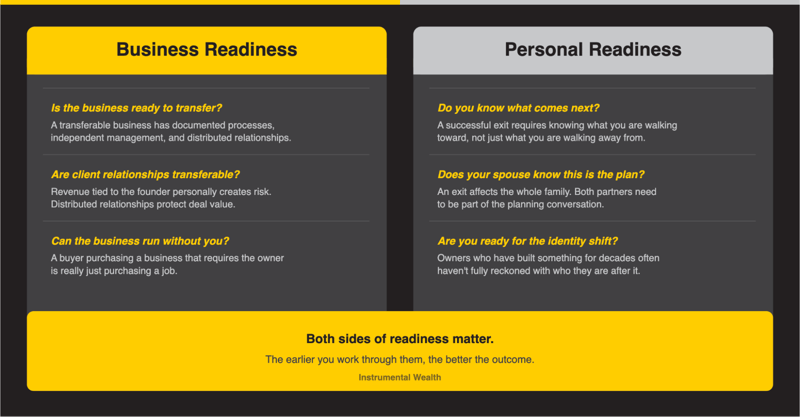
The first question we work through with clients is whether the business is actually prepared to transfer to a new owner. This is what we call business readiness, and it covers a set of concrete operational factors.
Does the company have documented standard operating procedures? Is there a management team in place that can carry the business forward? Are clients and customer relationships tied to the owner personally, or have they been distributed across a team of relationship managers and sales professionals?
These are the building blocks of a transferable business. Without them, a buyer isn't purchasing a company, they're purchasing a job. And a buyer who recognizes that will price accordingly.
Personal Readiness: Are You Ready for What Comes Next?
The second side of readiness is less talked about, and in some ways more difficult.
We had a client come in for a readiness conversation. Drew asked him directly: are you ready to step away? What does your life look like after this? The client lit up. He said he was going to love retirement, do whatever he wanted, enjoy every minute of it.
His wife, who was sitting right there, looked at him and said: no you're not. You're going to miss the office. You're going to miss the people you've worked alongside for twenty years. Be honest with yourself.
He didn't have an answer.
This plays out in different forms all the time. Business owners who have spent decades pouring themselves into a company often haven't thought carefully about the identity shift that comes with stepping away from it. That's not a financial planning problem. It's a personal one, and it needs to be addressed before a sale, not after.
This is also why we always want both spouses in the room for these conversations. In many families, one partner handles the day-to-day financial decisions while the other manages family life. But an exit is a decision that affects everyone, and the spouse who isn't running the business often has a clearer view of how the transition will actually feel.
Business Attractiveness: What Buyers Are Actually Looking For
There's also a third factor that drives valuation in ways business owners often don't anticipate: attractiveness.
A business can be operationally ready and personally meaningful to its owner and still score poorly on attractiveness from a buyer's perspective. Attractiveness is about transferability, how cleanly and confidently can a new owner step into this business and sustain what's already been built?
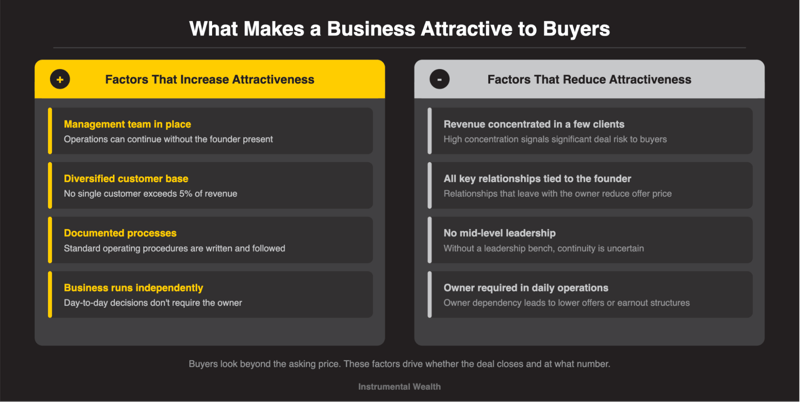
Buyers want to know that customer relationships won't walk out the door when the owner does. They want to see that revenue isn't concentrated in a handful of accounts. They want evidence that operations can continue without the founder in the room. When those things are in place, it opens the door to competitive offers and cleaner deal structures.
When they're not, the math changes quickly. A buyer who sees that 75% of revenue flows through three clients, and that all three relationships run through the owner personally, is looking at significant risk. They'll either reduce their offer to reflect that risk, build contingencies and earnouts into the deal structure, or both.
We worked with a client who had already signed a letter of intent with a private equity firm when they came to us. They liked the number on the LOI. But as the PE firm began its own due diligence (going through quality of earnings, asking about customer concentration, looking at how revenue was distributed) the number started coming down. Eventually the deal fell apart.
Both partners came back to us afterward. They said that watching the deal collapse was the clearest signal they could have received that there were real things to work on before they went back to market. That's where we are with them now.
Private equity in particular looks at businesses differently than a local buyer or strategic acquirer might. They look at EBITDA, but they also look at quality of earnings, e.g. who are your clients, how long have they been with you, what does your concentration look like, how dependent is the business on specific people. The LOI number is often just the starting point, and the diligence process is where the real negotiation happens.
What We Ask Our Clients
A few questions that tend to bring all of this into focus:
- Would you buy your business today, knowing everything you know about it?
- When was the last time you took a real vacation without being tied to your phone?
- If you stepped away tomorrow, what would break?
These questions can seem uncomfortable, but they're meant to give business owners a clear picture of where they actually stand, so that whatever time they have before an exit can be spent on the things that matter most.
If you're thinking about selling your business, whether that's two years from now or ten, we'd welcome the conversation. Reach out here or call our office directly at 813-578-7001.