

If you're anything like us, the past few weeks have been hard to ignore. Between the news cycle, the market moves, and the headlines piling up, it's natural to wonder what all of it means for your portfolio.
We've been compiling research that we thought was worth sharing. It looks at how markets have responded to major conflicts over the past several decades, and we think the historical context is genuinely helpful right now.
What Past Conflicts Reveal
The length, severity, and market reaction tied to international conflicts can vary. While these periods feel heavily influential as they happen, markets have historically absorbed them alongside broader economic forces.
They can stretch across multiple administrations, shifting rate environments, and entirely separate economic factors, which makes zooming out especially useful for advisors and clients alike.
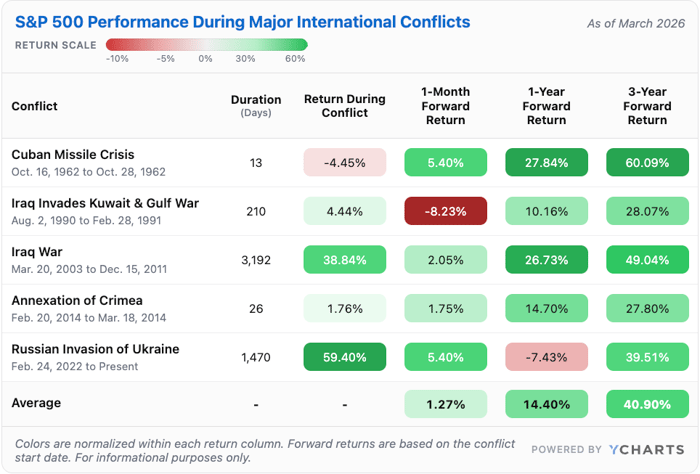
In the immediate 12 months after these events unfolded, the S&P 500 returned an average of 14.4%, outperforming its long-term average of 10.75%. Three years removed, and the market would have returned a minimum of 27%.
Applied to today’s S&P 500 level of 6,184, the average 3-year return of 40.9% would imply an index level above 8,700 by March 2029. That is not a forecast; rather, it helps frame today’s uncertainty against the longer-term perspective history has often provided.
Oil Responds First
Oil consistently experiences the sharpest responses when conflict breaks out in major energy-producing regions, as markets quickly price the risk of disrupted supply and transportation.
During the opening month of the Gulf War, Brent Crude rose by 45%, reaching $32.25 per barrel, as markets reacted to regional supply uncertainty.
.png?width=800&height=565&name=IBCOSPNK_chart%20(1).png)
Following the Russian invasion of Ukraine, Brent again surged, rising above $133 per barrel and finishing the first month more than 22% higher.
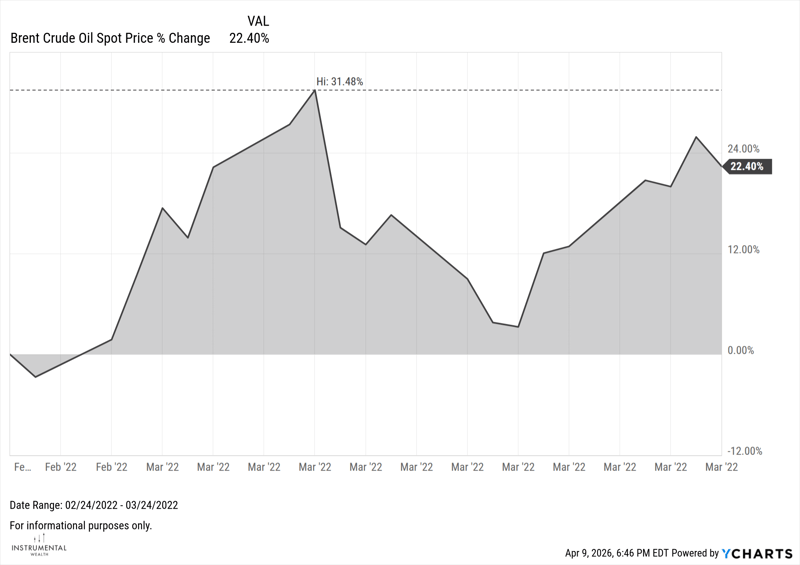
To no surprise, the same pattern has emerged in the first week following strikes on Iran. In the past five trading days, Brent Crude is up 25.6% and has crossed $90 per barrel for the first time since October of 2023.
Where International Pressure Builds
This pressure often reaches equities more quickly outside the United States, where higher energy costs carry broader economic implications.
The MSCI European Index fell 6.45% this past week, its biggest weekly decline since April 4, 2025, and its fifth worst week since the March 2020 pandemic drop of -20.28%. This sensitivity reflects Europe’s greater reliance on imported energy, where higher oil prices can feed more directly into production costs, transportation, and growth expectations.
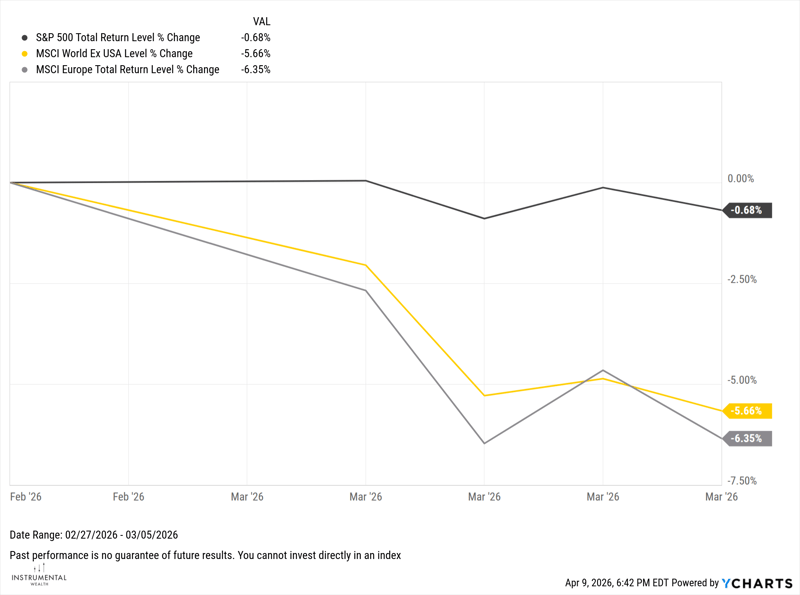
The US, by contrast, benefits from larger domestic energy production and an economy that can gradually absorb these pressures. The S&P 500 has remained more stable, down less than 1%, though underlying sector moves have been far more pronounced.
Dispersion Beneath the Index
Within U.S. equities, divergence is often one of the clearest reminders that periods of geopolitical uncertainty do not affect markets evenly.
Industries tied more directly to fuel costs, supply chains, or government spending expectations tend to react first as pressure or opportunity emerges. Major airline stocks have come under pressure as higher fuel costs begin to weigh on operating expectations.
.png?width=800&height=672&name=DAL_AAL_UAL_LUV_ULCC_JBLU_chart%20(1).png)
At the same time, select defense and government-linked names have moved higher, with Lockheed Martin and Northrop Grumman both up 2%, while Palantir is up over 14%.
These early sector moves are worth watching, but they're a reminder that geopolitical uncertainty doesn't affect all parts of the market the same way, and that short-term reactions and long-term outcomes are often very different things.
Staying Grounded
While uncertainty around the length and severity of the current conflict remains, history continues to favor investors who stayed disciplined through periods of geopolitical stress.
Oil prices, international equities, and sector-level moves all deserve attention as they influence broader economic sentiment, but markets have repeatedly moved beyond this initial shock period.
We know moments like this can feel unsettling, even when you know staying the course is the right call. If you have questions about your portfolio or just want to talk through what you're seeing in the news, don't hesitate to reach out. That's what we're here for.