

The first quarter of 2026 was a reminder that markets don't wait for ideal conditions. The three forces that drove the story were geopolitics, inflation, and monetary policy. What made Q1 unusual was how tightly those three became connected to one another. That connection is what I want to focus on, because understanding it matters more than any single data point from the quarter.
The Iran Conflict and the Energy Shock
The biggest story of Q1 was the escalation of the Iran conflict. What followed was one of the largest energy supply shocks in decades.
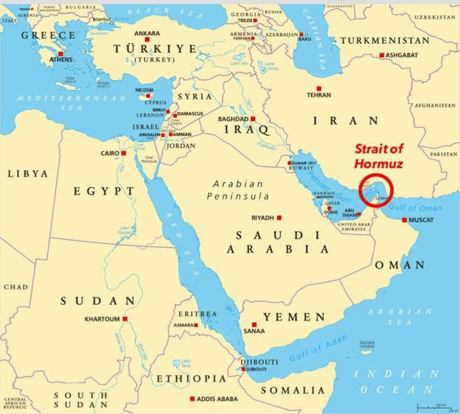
The Strait of Hormuz carries approximately 20% of the world's oil supply.¹
The conflict disrupted key infrastructure and shipping routes, particularly around the Strait of Hormuz. Global oil supply dropped as a result, and prices spiked quickly, briefly approaching $150 a barrel before settling closer to $100.¹
Higher energy prices function like a tax on the broader economy. Consumers feel it directly at the pump. Businesses see rising input costs across transportation, manufacturing, and production. And when those dynamics compound, overall growth expectations start to move lower.
Inflation: A Problem That Did Not Finish Solving Itself
Coming into 2026, inflation had been improving.
Then the energy shock hit on top of it.
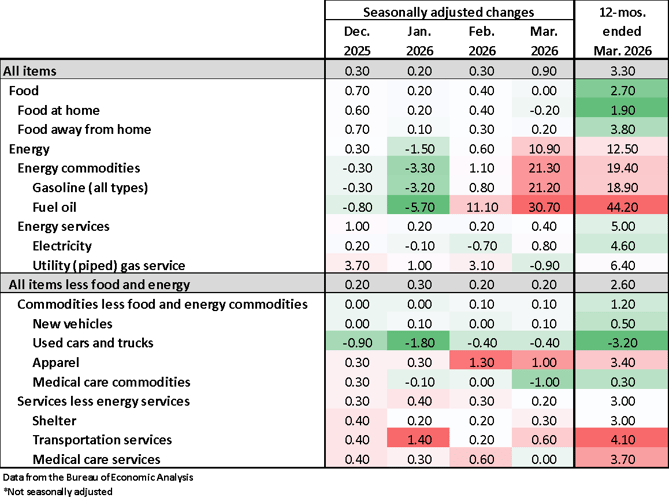
Source: U.S. Bureau of Labor Statistics. Seasonally adjusted monthly changes through March 2026.
As the above table shows, gasoline and energy commodity prices had been declining through December and January. Then, as the conflict escalated at the end of February, prices reversed sharply. Energy commodities rose 21.3% in March alone, and headline inflation for all items nearly tripled in that month, rising by approximately 0.9%.² The effects will likely continue to ripple through transportation, manufacturing, and food prices in the months ahead.
There is now a real risk that inflation moves back above 4% if these energy pressures persist.³
The Fed's Dilemma
At the start of 2026, markets were expecting a clear path toward rate cuts. The events of Q1 changed that.
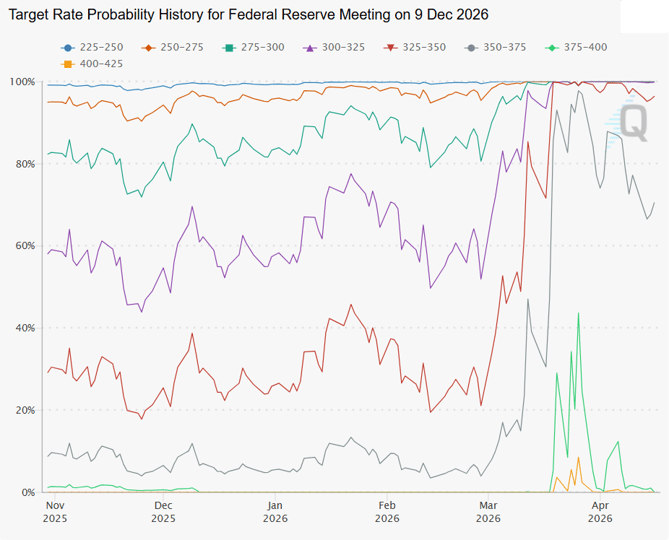

Source: CME FedWatch. Target rate probabilities for the December 9, 2026, Federal Reserve meeting. Data as of April 16, 2026.
The shift in market expectations is visible in the data. At the end of 2025, markets expected rates to land somewhere between 2.50% and 3.25% by December, implying one to three cuts over the course of the year. As of mid-April 2026, the market assigns a 70% probability to rates staying right where they are at 3.50% to 3.75%, with at most one cut priced in for the year.⁴
The Fed is now navigating two forces pulling in opposite directions. Rising inflation argues for keeping policy tight. Slowing growth argues for easing. Rather than moving toward cuts, the Fed has shifted to a more cautious, data-dependent stance, and that has created more uncertainty for markets across both equities and fixed income.⁴
How These Forces Connected
The events of Q1 were, in effect, one chain reaction. The Iran conflict drove an energy shock, that energy shock pushed inflation higher, and higher inflation limited the Fed's ability to cut rates, even as growth was slowing. The combination produced elevated volatility across stocks and bonds and forced markets to reassess assumptions that had seemed settled going into the year.
This is also an important reminder of why diversification matters, and how one big, unexpected event can cause significant change in the markets and lead to results completely different from previous expectations.
A Look at the Rest of 2026
Geopolitics: The Variable That Drives Everything Else
The trajectory of the Iran conflict continues to be perhaps the single most consequential macro variable for the year. Our base case is partial de-escalation rather than full resolution. Under that scenario, energy markets gradually stabilize, oil prices ease from peak levels but stay elevated relative to where they started the year, and headline risk continues to drive periodic volatility.
Equities: Broader Leadership, Not a Complete Shift
For most of the past decade, US equities, especially large-cap technology, dominated global returns. That changed last year. A significant decline in the US dollar helped both international developed and emerging markets outperform US equities in 2025, and international markets have continued to lead early in 2026, though the Iran conflict has driven considerable volatility in those markets as well.
International equities carry some structural advantages heading into the rest of the year. Valuations remain more attractive. A weaker dollar, if the trend continues, provides a tailwind for returns. And if US economic growth slows as expected, that creates a more favorable relative backdrop for global markets.
US equities still have strengths, with a key one being continued leadership in AI and technology. Our view is that 2026 is a year of broader leadership and more global participation, not a decisive end to US strength.
The US Economy: Slower but Still Growing
Our base case for the US economy is continued growth in the 1.5% to 2.5% range, a step down from recent years, but not a recession.
What This Means for Portfolios
Staying away from large, concentrated bets and maintaining balance across regions, sectors, and asset classes is likely the most effective way to navigate what's ahead. Portfolios built that way don't require getting every major macro call right, and that matters in an environment like this one.
If you would like to talk through how any of this relates to your own situation, our team is here. Reach out.
¹ Reuters, "IEA warns Iran war oil shock will cut supply, cause demand to shrink," April 2026. reuters.com
² U.S. Bureau of Labor Statistics, Consumer Price Index, March 2026. bls.gov/cpi/
³ Econoday, "Last Week in Review: Energy Shock Hits US CPI." econoday.com
⁴ CME Group, FedWatch Tool. cmegroup.com