

If you're a business owner asking yourself 'Is it time to sell?' you may be approaching this decision in a way that leads many business owners to regret their exit.
But when most business owners start thinking about selling, they fall into what I call the "timing trap."
The timing trap is when business owners believe that the decision to sell should be based on external market conditions, their age, or how they're feeling about the business on any given day. This reactive approach to one of the most important financial decisions of your life ignores the systematic preparation that actually determines whether your exit will be successful or disappointing.
Here's how this trap developed: For decades, business owners have been conditioned to think about exit planning as something you do when you're "ready to retire" or when market conditions look favorable.
This creates a real challenging situation for many, where business owners wake up one day, decide they want to sell, and expect to achieve their retirement dreams without any advance planning.
The result? Rushed decisions, lower valuations, significant tax consequences and implications, and the disappointing realization that they haven't built a business that can fully fund their ideal retirement.
The reality is many business owners discover too late that the question isn't when should I sell, but rather, am I building a business worth selling?
There are three critical strategies we strongly advise implementing before you even consider putting your business on the market.
These strategies separate the successful 30% who exit without regret from the 70% who wish they'd started planning years earlier and regret their decision. But here's what most business owners don't realize: these aren't exit strategies – they're business optimization strategies that happen to make your eventual exit infinitely more successful.
STRATEGY 1: ASSESS YOUR THREE GAPS BEFORE TIMING THE MARKET
The first strategy is conducting a comprehensive Three Gaps Analysis before you make any decisions about timing your exit. Most business owners focus on external factors – "Is this a good time to sell in my industry?" or "Are valuations high right now?" – when they should be focusing on internal readiness.
This internal-first approach matters because external market timing is largely outside your control, but your business's readiness is completely within your control. I've seen business owners wait for "perfect market conditions" while their business deteriorates, and I've seen others sell in challenging markets but achieve exceptional outcomes because their business was optimized.
The Three Gaps Analysis reveals exactly where you stand:
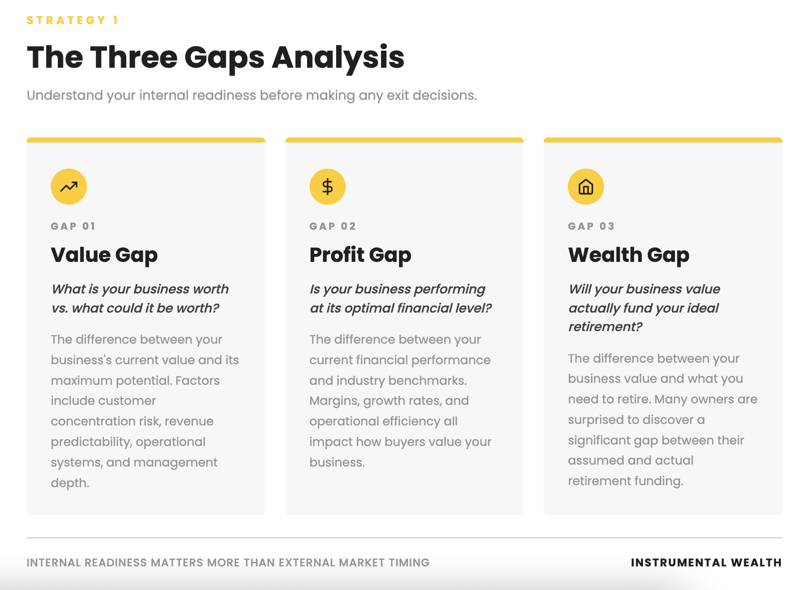
The Value Gap: What's the difference between your business's current value and its maximum potential? If you haven't systematically addressed the factors that drive valuation – customer concentration risk, revenue predictability, operational systems, management team depth – you're leaving money on the table regardless of market timing.
The Profit Gap: Is your business performing at its optimal financial level compared to industry benchmarks? If your margins, growth rates, or operational efficiency lag behind industry standards, no amount of market timing will compensate for that gap.
The Wealth Gap: What's the difference between your business value and what you actually need to fund your ideal retirement? This is where most business owners get the biggest shock – they assume their business is worth enough to fund their retirement, only to discover they're millions short of their goals.
When you understand these gaps first, you can make informed decisions about timing. You might discover you need three more years of systematic improvement to achieve your financial goals, or you might realize you're already positioned for a successful exit and shouldn't wait for "perfect" market conditions.
STRATEGY 2: BUILD EXIT-READINESS INTO YOUR BUSINESS OPERATIONS
The second strategy is what I call "exit-ready optimization" – running your business as if you're always one year away from a potential exit, regardless of your actual timeline.
This approach forces you to address the operational gaps that destroy business value. Buyers don't just purchase your current cash flow – they're buying your business's ability to generate predictable cash flow without you. If your business can't run without you, or if critical processes exist only in your head, you don't have a sellable business – you have an expensive job.
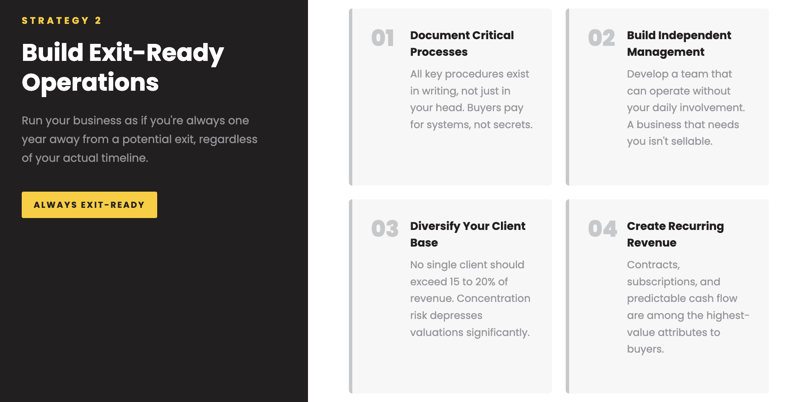
Exit-ready optimization means:
- Documenting all critical processes and procedures
- Building management systems that don't depend on your daily involvement
- Diversifying your customer base so no single client represents more than 15-20% of revenue
- Creating predictable revenue streams through contracts, subscriptions, or recurring business models
- Developing a management team that can operate independently
Every single improvement that makes your business more exit-ready also makes it more profitable and less stressful to run. You're not preparing to exit – you're building a better business that happens to be highly sellable.
STRATEGY 3: COORDINATE YOUR EXIT PLANNING WITH YOUR WEALTH PLANNING
The third strategy addresses the biggest mistake I see business owners make: treating their exit as purely a business transaction instead of a comprehensive wealth transition.
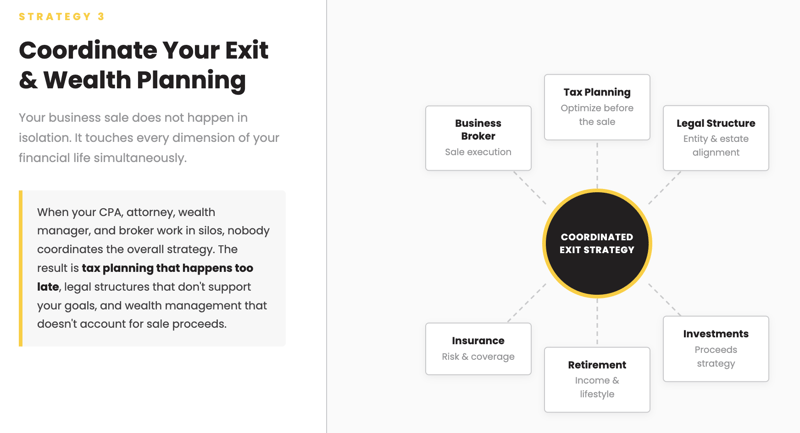
Your business sale doesn't happen in isolation – it impacts your tax situation, estate planning, investment strategy, insurance needs, and retirement timeline. Most business owners work with advisors in silos: their CPA handles taxes, their attorney handles legal structure, their wealth manager handles investments, and their business broker or investment banker handles the sale. Nobody coordinates the overall strategy.
This siloed approach creates expensive problems:
- Tax planning happens after the sale, when it's too late to optimize any major tax reduction strategies
- Business improvements conflict with personal financial goals
- Legal structures don't optimize for exit strategy
- Wealth management doesn't account for business sale proceeds
Coordinated planning means your exit strategy aligns with your tax optimization, your business improvements support your wealth goals, and your legal structure helps maximize your after-tax proceeds. The difference can literally be millions of dollars in your pocket.
Instead of asking, is it time to sell? Start asking, am I building an exit-ready business that will fund my ideal retirement?"
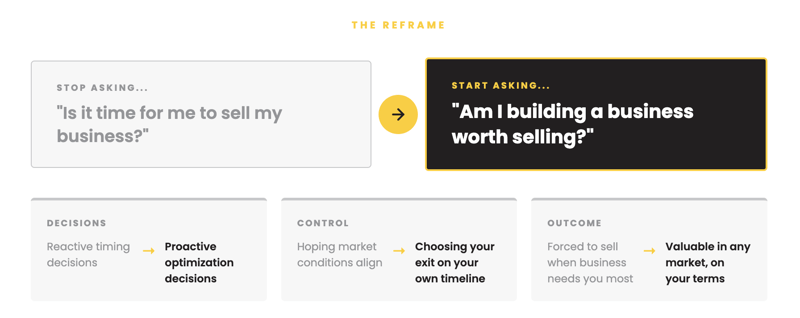
This reframe changes everything. Instead of reactive timing decisions, you make proactive optimization decisions. Instead of hoping market conditions align with your retirement timeline, you systematically build a business that's valuable in any market.
The successful 30% understand that exit planning isn't about timing the market – it's about building a business so valuable and well-positioned that you have the luxury of choosing your exit timing based on your personal goals, not market conditions or business desperation.
These three strategies – conducting your Three Gaps Analysis, building exit-readiness into your operations, and coordinating your business and wealth planning – transform the question from "When should I sell?" to "How do I build a business worth selling?"
When you implement these strategies, timing becomes a choice rather than a constraint. You're no longer at the mercy of market conditions or forced to sell when your business needs you most.
The difference between those who join the successful 30% and those who experience exit regret isn't luck or timing – it's systematic preparation.
That's why we've created a comprehensive Exit Planning Readiness Assessment that reveals exactly where you stand across all three gaps. This assessment takes just five minutes to complete, and you'll immediately see whether you're in High Readiness (40-48 points), Moderate Readiness (30-39 points), Low Readiness (20-29 points), or Early Stage (below 20 points).

More importantly, you'll discover the specific areas where you can take action now to close these gaps and build the exit-ready business you deserve.
Don't join the 70% who regret their exit decisions. Take our Exit Planning Readiness Assessment now and discover exactly what gaps might be preventing you from achieving your ideal exit.
Schedule a conversation with our team to discuss your situation and explore how we can help.