

The market just wrapped its third consecutive year of double-digit gains. Your portfolio statement probably looks solid. So why does something still feel a little off?
You’re not imagining it. The S&P 500 (Standard & Poor's 500 Index, a market-capitalization-weighted index of 500 leading publicly traded US companies) surged 17.88% in 2025, its third straight year of double-digit returns, driven almost entirely by concentration in tech and mega-cap names.*
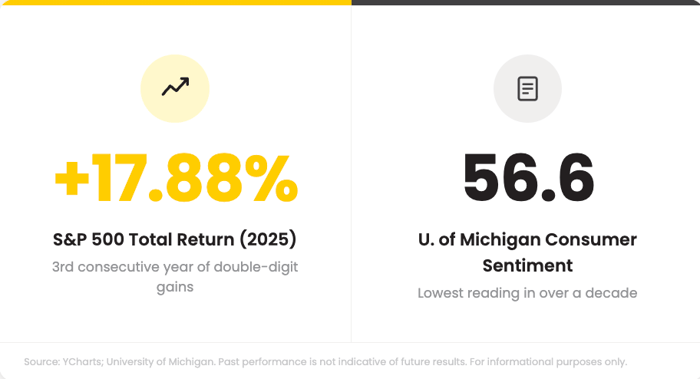
But at the same time, consumer sentiment has been falling off a cliff. The University of Michigan’s Consumer Sentiment Index dropped to 56.6 through February 2026, its lowest reading in over a decade, while the Conference Board’s Consumer Confidence Index fell to 91.2 through February.* Stock prices up, confidence down. That’s a strange pairing. Investors are also feeling less confident about the markets specifically. According to the AAII Investor Sentiment Survey, only 33% of investors currently identify as bullish, compared to 40% who are bearish. The bull-bear spread has fallen to -6.56%, meaning more investors are pessimistic about where markets are headed than optimistic.*
Charles Schwab has actually coined a term for all of this: a “vibepression.” It’s a consumer sentiment depression running alongside continued GDP growth. They attribute the disconnect to tariffs and AI-related labor anxiety.* I think that’s part of it. But there’s more going on beneath the surface.
Markets can hit record highs and real risk can still be rising at the same time. That’s where we are. And right now, several converging forces make the case for genuine diversification (not the bumper-sticker version, but the real thing) stronger than it’s been in years.
* YCharts. S&P 500 Total Return — https://ycharts.com/indicators/sp_500_total_return_annual
*ainvest.com, Market Concentration: The S&P 500's Record Year https://www.ainvest.com/news/market-concentration-500-record-year-history-warns-2026-2512/
* The Conference Board, Consumer Confidence Index — https://www.conference-board.org/topics/consumer-confidence
* Charles Schwab, 2026 US Stock Market Outlook — https://www.schwab.com/learn/story/us-stock-market-outlook
* American Association of Individual Investors (AAII) Investor Sentiment Survey — https://www.aaii.com/sentimentsurvey
Table of Contents
The Narrow Foundation Markets Are Built On
Most people who own an S&P 500 index fund believe they’re diversified. And I get why. It’s 500 companies, after all. But that number is misleading.
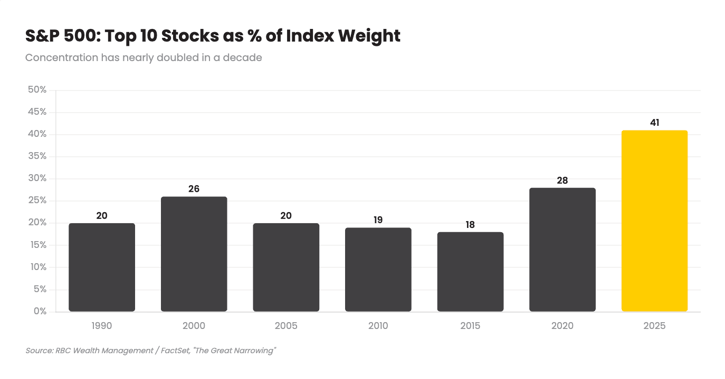
By the end of 2025, the 10 largest companies in the S&P 500 accounted for nearly 41% of the index’s total weight. That’s more than double what it was just 10 years ago. Between 1990 and 2015, the top 10 weighting hovered steadily in the 18–23% range.* That era of balance is gone. Just five tech stocks accounted for roughly 45% of the index’s benchmark returns last year.*
Here’s the part that doesn’t get talked about enough: those top 10 stocks represent about 41% of the index’s weight but were on track to generate only about 32% of its earnings.
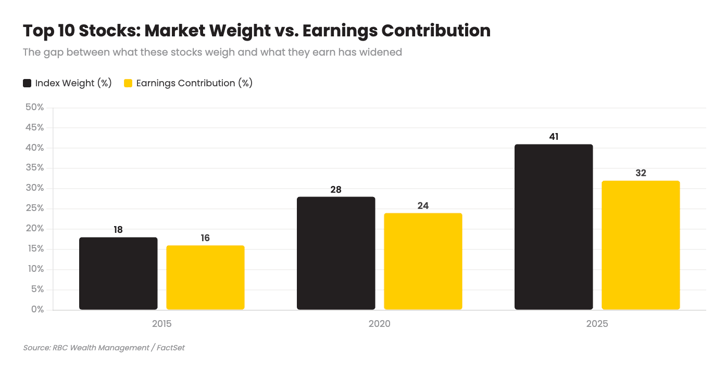
That gap between market cap concentration and actual earnings contribution has widened meaningfully since 2015.* In plain terms, the stocks driving the market’s returns are more expensive relative to what they earn than they used to be.
History offers some context. The two most concentrated periods before this one were 1980 and the early-2000 tech bubble peak, when the top ten represented about 26% of the market. We’re well past that now.
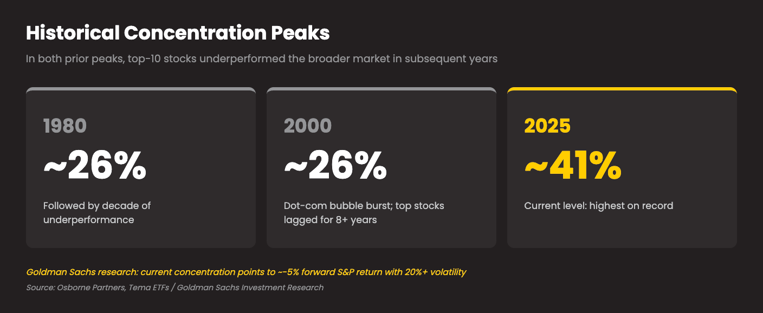
And in both of those prior cases, the top-ten stocks went on to underperform the broader market in the years that followed.* Goldman Sachs research suggests the current concentration levels point to a forward return on the S&P 500 of approximately -5%, with volatility expected north of 20%.*
None of this means you should dump your index fund tomorrow. But it does mean that if you own a standard index fund and think you’re broadly diversified, you’re actually making a concentrated bet on a handful of technology and AI-adjacent companies. That’s not inherently wrong, but it should be a conscious choice, not something you stumble into by default.
RBC Wealth Management / FactSet, "The Great Narrowing"
https://www.rbcwealthmanagement.com/en-us/insights/the-great-narrowing-sp-500-concentration
ainvest.com / Bloomberg data
https://www.ainvest.com/news/market-concentration-500-record-year-history-warns-2026-2512/
RBC Wealth Management / FactSet, concentration vs. earnings
https://www.rbcwealthmanagement.com/en-us/insights/the-great-narrowing-sp-500-concentration
Osborne Partners, The S&P 500 Concentration (January 2025)
https://osbornepartners.com/the-sp500-concentration/
Tema ETFs / Goldman Sachs Investment Research
https://temaetfs.com/insights/how-to-stay-invested-in-sp-500-with-reduced-concentration-risk
Four Structural Forces That Make This Moment Different
What concerns me most isn’t the normal cyclical stuff. Recessions come and go, markets correct and recover. What’s happening now is structural, and these are forces that could persist for years.
The End of the Unipolar World Order
The World Economic Forum’s Global Risks Report for 2026 lays this out plainly: the world is shifting from a unipolar order to a multipolar one, and that transition is bringing fewer multilateral constraints on unilateral action, rising national barriers, and clashing interests with real economic consequences.*
Wellington Management puts it in historical terms. Geopolitical cycles tend to last between 80 and 100 years, and structural changes at this scale only come around once per century. They tend to be disruptive. Wellington’s assessment of 2026 is that we’re “a long way from Goldilocks.”* Rabobank’s 2026 global outlook echoes that theme: the rules-based global order that underpinned international trade and investment for decades continues to erode. Last year dismantled old certainties. This year will likely be about the messy emergence of new ones.*
For decades, investors could assume a relatively stable set of global trade rules underwritten by American power. That assumption is no longer reliable, and portfolios built around it carry risks they didn’t before.
Recent events in the Middle East are a current example of exactly this kind of risk. The US strikes on Iranian nuclear facilities were not something most investors saw coming. Markets reacted, particularly international and emerging markets, which saw significant single-day declines. That kind of unexpected geopolitical shock is precisely why broad diversification matters. If a portfolio had been concentrated in those international markets alone, the impact would have been substantial. Holding exposure across geographies, sectors, and asset classes is what reduces the damage when one area gets hit by something nobody predicted.
* World Economic Forum, Global Risks Report 2026 — https://www.weforum.org/publications/global-risks-report-2026/
Wellington Management, Geopolitics in 2026 (January 2026)
https://www.wellington.com/en/insights/geopolitics-in-2026-risks-and-opportunities-were-watching
Rabobank, Global Outlook 2026: New Rules, Different Economy
https://www.rabobank.com/knowledge/q011509552-global-outlook-2026-new-rules-different-economy
Tariffs: More Than a Headline
The US effective tariff rate surged dramatically in 2025, reaching levels not seen in a century.* This isn’t posturing. Since tariffs were announced in April 2025, cumulative customs and excise tax revenue ran approximately $88 billion higher compared to the same period in 2024, according to BlackRock.
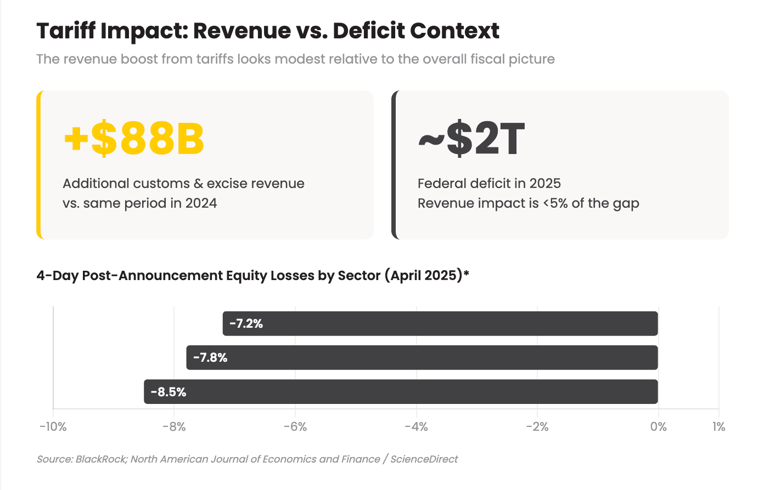
But set that against a federal deficit running at nearly $2 trillion, and the revenue impact looks modest relative to the overall fiscal picture.*
The market impact was immediate and broad. A peer-reviewed study published in the North American Journal of Economics and Finance found the April 2025 tariff announcements sparked sell-offs across global equity markets, with the sharpest declines in energy, basic materials, and technology, averaging cumulative losses between 7% and 9% over just four trading days.*
Morgan Lewis notes that tariffs are being deployed not just as economic tools but as national security instruments, affecting everything from steel and aluminum to semiconductors and pharmaceuticals. Their assessment heading into 2026: companies should expect continued tariff movement, growing export controls, and trade enforcement investigations.*
The policy trajectory has proven that point directly. In early 2026, the Supreme Court ruled that the administration had overstepped its authority in the way tariffs were originally implemented. The administration has since indicated tariffs will still move forward through other legal mechanisms. Tariffs are creating real winners and losers across sectors, and that uncertainty is not going away. Portfolios concentrated in sectors with heavy trade exposure face risks that simply weren’t on the table five years ago.
* whalesbook.com, Global Trade Realignment — https://www.whalesbook.com/insights/global-trade-realignment-2025
BlackRock, What Tariffs May Mean for the Economy and Portfolios
https://www.blackrock.com/us/financial-professionals/insights/tariffs-economy-and-portfolio
North American Journal of Economics and Finance / ScienceDirect
https://www.sciencedirect.com/science/article/abs/pii/S0275531925001813
Morgan Lewis, US International Trade and Investment: Key Shifts in 2025 (January 2026)
https://www.morganlewis.com/pubs/2026/01/us-international-trade-and-investment-key-shifts-in-2025-and-what-businesses-should-know-for-2026
The US Fiscal Picture: From Abstract Risk to Market Reality
For most of my career, this was a topic you’d hear about at conferences and then promptly forget. It was always “a long-term concern.” That’s changing.
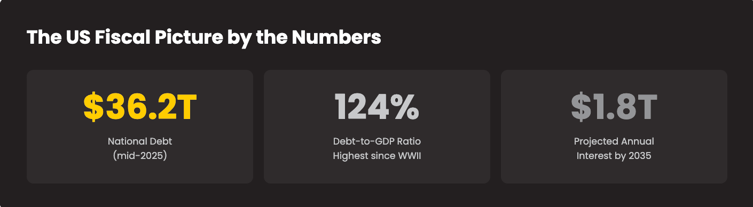
US national debt stands at $36.22 trillion as of mid-2025. That’s 124% of GDP, the highest level since World War II. Interest payments on that debt are projected to exceed $1.8 trillion annually by 2035. That’s more than current federal spending on defense, education, and transportation combined.*
In May 2025, Moody’s downgraded the US credit rating, making it the last of the three major agencies to strip the country of its top-tier AAA status. Moody’s had held that rating since 1917, through the Great Depression, World War II, and the 2008 financial crisis.*
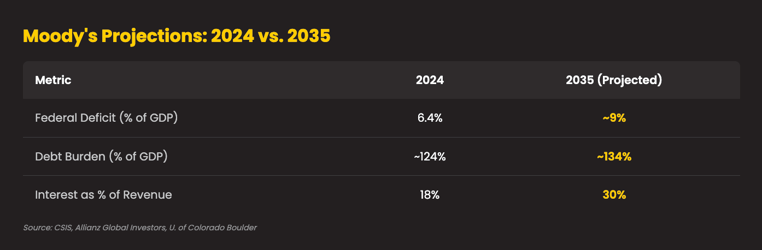
Their projections show federal deficits reaching nearly 9% of GDP by 2035, up from 6.4% in 2024, with interest payments absorbing 30% of revenue by that same year.*
As one market strategist put it: the government deficit isn’t a problem until investors think it is. The Moody’s downgrade arrived at what Callie Cox at Ritholtz Wealth Management called “a wildly inopportune time for the fixed-income market” at a moment when the world was already second-guessing US debt.*
For generations, US Treasury bonds were the definitional “risk-free” asset. All three major ratings agencies have now downgraded the United States. That doesn’t mean Treasuries are dangerous. But it does mean that building a portfolio around the assumption of US debt as the ultimate safe harbor carries more nuance than it once did.
CSIS, Moody's Downgrade Signals Deeper Risk (May 2025)
https://www.csis.org/analysis/moodys-downgrade-signals-deeper-risk-us-debt-undermining-global-leadership
University of Colorado Boulder, What the US Credit Downgrade Means
https://www.colorado.edu/today/2025/05/21/what-us-credit-downgrade-means-economy-and-your-wallet
* Allianz Global Investors, US Rating Downgrade — https://www.allianzgi.com/en/insights/outlook-and-commentary/us-rating-downgrade
Axios / Callie Cox, Ritholtz Wealth Management
https://www.axios.com/2025/05/19/moodys-credit-rating-us-debt-reason
AI: Disruptive Force, Not Just an Investment Theme
At Davos in January 2026, the IMF’s (International Money Fund) managing director said AI is hitting the labor market “like a tsunami,” and that most countries and businesses are not prepared for it. The IMF estimates AI could boost growth by up to 0.8% over the coming years, but the labor market disruption is the more immediate concern.*
Research from the Brookings Institution adds an uncomfortable dimension: higher-income, white-collar occupations requiring postsecondary education show the highest exposure to AI capabilities.* That’s the demographic that makes up most of our client base. It’s not factory floors that are most exposed here. It’s boardrooms and corner offices.
J.P. Morgan’s Global Markets Strategy team warns that AI could further amplify polarization within what they describe as an already unhealthy K-shaped economy, and that market concentration could reach new highs as a result.* Broad sentiment measures, they note, remain prone to sharp swings even though underlying trends remain intact.
AI is simultaneously one of the greatest investment themes of the decade and a source of legitimate disruption anxiety for the people earning the money that gets invested. Both sides of that equation matter when we think about how to build portfolios, and how we talk with clients about them.
CNBC / IMF, World Economic Forum Davos (January 2026)
https://www.cnbc.com/2026/01/20/ai-impacting-labor-market-like-a-tsunami-as-layoff-fears-mount.html
Brookings Institution, Measuring US Workers' Capacity to Adapt to AI-Driven Displacement (February 2026)
https://www.brookings.edu/articles/measuring-us-workers-capacity-to-adapt-to-ai-driven-job-displacement/
* J.P. Morgan Global Research, 2026 Market Outlook — https://www.jpmorgan.com/insights/global-research/outlook/market-outlook
What “Real Diversification” Actually Means in 2026
In this environment, diversification means more than just splitting money between stocks and bonds. It requires deliberate decisions across geographies, sectors, and asset classes.
Geographic Diversification and the Dollar Dynamic
The US dollar fell nearly 10% through September 2025, marking its worst stretch for that period in more than a decade. It depreciated 13.5% against the euro and 13.9% against the Swiss franc. Morningstar’s assessment is direct: the dollar’s weakness in 2025 likely signals a turning point in its long cycle of strength, and global diversification may play a more meaningful role in portfolio returns going forward than it has in the recent past.*
The numbers bear that out. J.P. Morgan Asset Management notes that the MSCI EAFE index (an index measuring the performance of developed market equities across Europe, Australasia, and the Far East, excluding the US and Canada) delivered a 22% year-to-date return in 2025, with roughly 10% of that return attributable directly to dollar weakness.* US-only investors missed that tailwind entirely.
Charles Schwab’s 2026 international outlook argues that international stocks could be poised for another strong year due to accelerating global growth, attractive valuations, and continued dollar weakness.* They see developed-market international stocks as a natural diversifier for portfolios heavily weighted toward the tech-concentrated S&P 500. BlackRock goes further, noting that international equities may actually be a better diversifier to US large caps than the small-cap overweight most advisors currently hold, precisely because international indexes have bucked the concentration trend.*
Morningstar, What a Weaker US Dollar Means for Investors in 2026 (December 2025)
https://www.morningstar.com/economy/what-weaker-us-dollar-means-investors-2026-beyond
J.P. Morgan Asset Management, Where Is the US Dollar Headed?
https://am.jpmorgan.com/us/en/asset-management/adv/insights/market-insights/market-updates/on-the-minds-of-investors/where-is-the-us-dollar-headed-in-2025/
Charles Schwab, 2026 International Stock Market Outlook
https://www.schwab.com/learn/story/international-stock-market-outlook ✓ (your original URL is live and correct — no change needed)
BlackRock, Dollar Weakness Boosts International Appeal
https://www.blackrock.com/us/financial-professionals/insights/investing-international-equities
Sector Diversification: Beyond the Magnificent Seven
The 2025 market told two very different stories depending on where you were positioned. Non-AI software stocks had a significant correction. Salesforce fell 23%, Adobe dropped 25%, ServiceNow lost 30%. Meanwhile, aerospace and defense surged (GE Aerospace up 94%, RTX up 63%), and gold and mining stocks rallied as central bank buying and geopolitical risk pushed prices to record highs.*
Josh Brown at Ritholtz Wealth Management captured this well in his year-end review: yes, the market is concentrated, but no, it’s not only a tech market or a Magnificent Seven market. The lesson he draws is one I agree with. Diversification works best when it’s part of a deliberate plan, not a reaction to discomfort.*
* Visual Capitalist / Finviz, S&P 500 Market Concentration Over 145 Years — https://www.visualcapitalist.com/sp-500-market-concentration-145-years/
* YCharts / Josh Brown, Ritholtz Wealth Management, What Did Market Concentration Really Mean in 2025? — https://ycharts.com/resources/blog/market-concentration-2025
We Don’t Need to Predict the Future
I want to close with something I think gets lost in all the data and all the risk talk.
Diversification was never designed for certainty. It was designed for exactly the kind of environment we’re in: one where multiple plausible scenarios exist, and where nobody (not the Fed, not the IMF, not anyone on financial television) can tell you with confidence which one plays out.
A review from Journey Strategic Wealth notes that globally diversified portfolios actually outperformed in 2025 for two connected reasons: broadened growth as non-US markets began catching up after a long period of “US Exceptionalism,” and currency tailwinds as dollar weakness boosted returns from overseas assets. That’s a benefit US-only portfolios missed completely.*
The S&P concentration data from the last cycle is instructive here. From the 2000 peak through 2008, the Russell 1000 Growth Index (an index measuring the performance of the large-cap growth segment of US equities) fell over 57%, annualizing at nearly 10% losses per year for more than eight years. Over that same stretch, which included two of the worst bear markets in a century, the Russell 1000 Value Index (an index measuring the performance of the large-cap value segment of US equities) fell only 9% total. Same timeframe. Radically different outcome. The difference was diversification.*
When we talk about diversification at Instrumental Wealth, we don’t mean owning 500 stocks and calling it a day. We mean building a portfolio across geographies, sectors, and asset classes, deliberately, with today’s specific risks in mind, so that no single scenario, whether it’s AI disruption, a geopolitical shock, tariff escalation, or dollar weakness, can derail your plan.
That’s not being defensive. That’s being prepared.
Schedule a conversation with our team to discuss your situation and explore how we can help.
Journey Strategic Wealth / Advisor Perspectives, What 2025 Revealed About Market Leadership (January 2026)
https://www.advisorperspectives.com/commentaries/2026/01/15/2025-revealed-market-leadership-portfolio-resilience
Osborne Partners, The S&P 500 Concentration (January 2025)
https://osbornepartners.com/the-sp500-concentration/