

Volatility continued to test investors through the second quarter of 2026. Between geopolitical headlines, a leadership change at the Federal Reserve, and a notable shift in global market leadership, there was plenty for investors to absorb.
In our Q2 2026 Market & Economic Update, CEO David Silver and Chief Investment Officer Matthew Harbert, CFA, walk through what shaped the quarter and the themes we are watching for the rest of the year. You can watch the full conversation or read the recap below.
Geopolitics and the Iran conflict stayed front and center
The Iran conflict that began in the first quarter remained the dominant story through the second quarter. What moved markets, though, was less the conflict itself and more the uncertainty around whether and when it might be resolved.
Investors experienced a steady cycle of optimism and concern. Headlines shifted week to week between military escalation, diplomatic negotiations, ceasefire discussions, renewed military action, and additional sanctions. Markets often moved higher or lower on the latest headline, only to reverse course days later.
Those repeated head fakes reinforced a familiar lesson: at times, the most useful response to a rapid news cycle is to look past the headlines and stay focused on the longer-term picture.
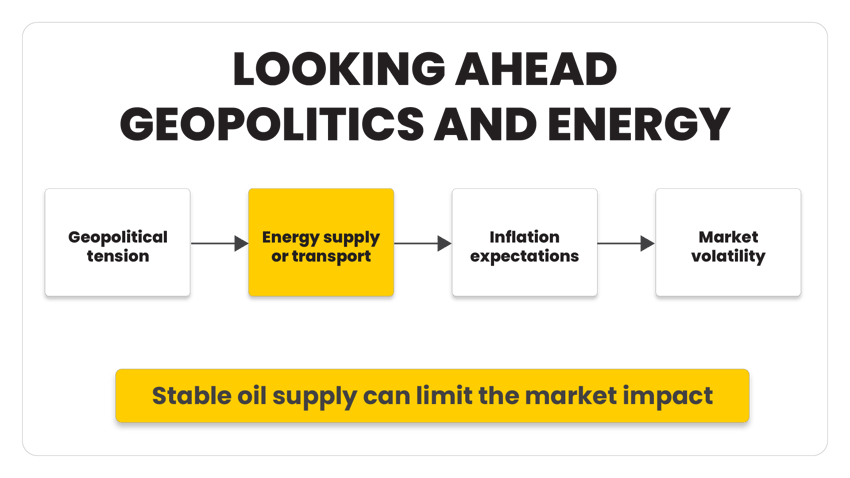
The core concern behind the conflict held steady all quarter. As the situation progresses, could it disrupt energy markets enough to reignite inflation? So far, those fears have not been fully realized, though the possibility remains an important risk to monitor.
A new chapter at the Federal Reserve
While geopolitics led the headlines, a significant development unfolded more quietly. On May 22nd, Kevin Warsh replaced Jerome Powell as chairman of the Federal Reserve.
Changes in Federal Reserve leadership matter because investors do not simply react to current interest rate decisions. They are constantly trying to anticipate future policy and how it may affect markets. A new chair raises two important questions: what policies will the new chair champion, and how will the new chair communicate them?
Those questions carry extra weight right now because the economic data is so mixed. Inflation has demonstrated to be more persistent than many expected, particularly with the Iran conflict fueling concern about energy prices. At the same time, employment and consumer spending have slowed but remain relatively healthy. Historically, conditions like these would argue for maintaining restrictive policy, or even raising rates if inflation were to accelerate again.
Why the dot plot matters
Adding to the uncertainty is a question of transparency. Several comments from Federal Reserve officials have raised the possibility of sharing less information publicly, even hinting at discontinuing the dot plot.
The dot plot is a chart showing each Fed member's view of where interest rates should sit over different time periods. For years, investors have relied on it to better understand how officials expect rates to evolve. It was never meant to be read as an exact path for rates, but it does offer valuable insight into the committee's thinking.
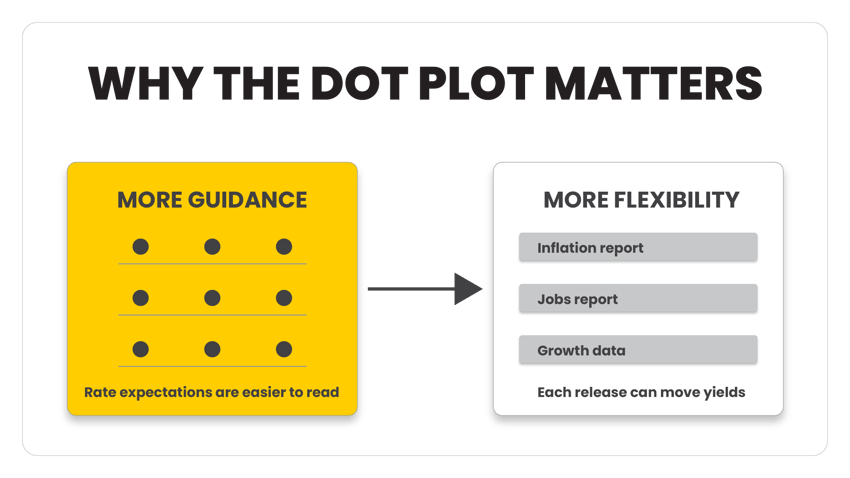
Some officials have suggested the dot plot may no longer provide the clarity it once did, and have discussed leaning more on incoming economic data while keeping future decisions flexible. That approach gives the Fed more room to maneuver, but it also gives investors less guidance. With less direction to work from, markets may need to do more guessing about the committee's intentions, which could lead to greater volatility in the rate markets as investors continuously reprice future policy.
Emerging markets took the lead
The final story worth highlighting was how international markets compared with U.S. markets. For the quarter, U.S. equities outperformed developed international equities. The standout, however, was emerging market equities, which outperformed both U.S. and developed markets by a wide margin. Year to date, emerging markets have more than doubled the returns of both U.S. and developed equities.
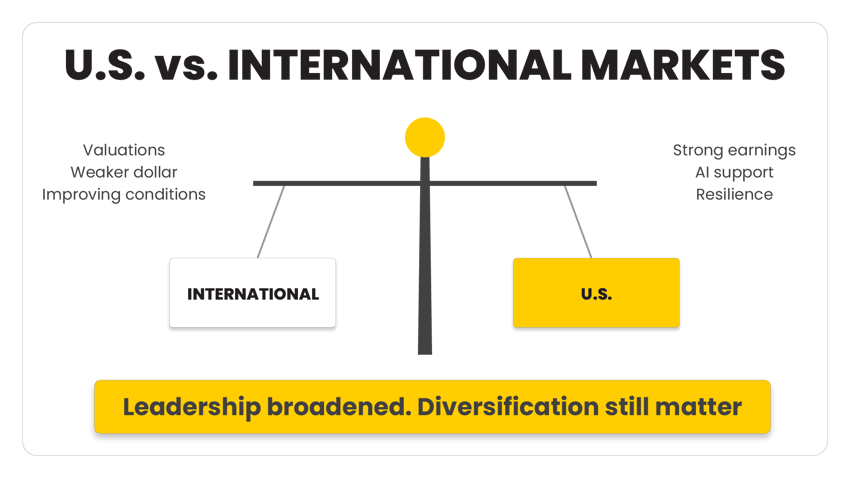
A few factors likely contributed to that strength:
- Artificial intelligence. While the U.S. has a strong AI infrastructure supporting its markets, many emerging economies are deeply woven into AI supply chains, such as Taiwan in semiconductors, South Korea in memory chips, and China in infrastructure.
- Commodity strength. Many emerging markets are heavy commodity exporters, and strong commodity performance has been a tailwind.
- Capital rotation. After years of U.S. outperformance, some investors began reallocating globally. As concerns about U.S. valuations grew, capital flowed toward markets where valuations looked more attractive.
- Faster economic growth. Growth has simply been quicker in many of these emerging economies.
Looking ahead
Geopolitics is likely to remain one of the largest sources of uncertainty. We anticipate that news may continue to swing back and forth between the prospect of resolution and renewed tension in the Iran conflict, and markets could stay volatile until a resolution is reached.
Energy prices are an important variable to watch. As long as global oil supplies stay relatively stable, markets may become more willing to look past the tensions. Any event that meaningfully disrupts energy production, however, could quickly revive inflation concerns.
On the Fed, we are paying close attention to what kind of committee this becomes. Current data presents a difficult challenge: inflation remains above the Fed's long-term objective, while labor and consumption remain relatively healthy. Historically that combination would argue for tighter policy, yet the consensus seems to be that this Fed may be less inclined to raise rates. It will take a few meetings to get a clearer read on how hawkish or dovish the committee is.
Communication is the other piece. If the new Fed places less emphasis on forward guidance and investors receive less information, we anticipate greater volatility in the rate markets. That, in turn, can influence borrowing costs and ultimately affect equity valuations. In other words, how the Fed communicates may become nearly as important as the policy itself.
Key takeaways for long-term investors
Three themes defined the quarter. Geopolitical uncertainty remained a central feature. The Federal Reserve entered a new chapter that may reshape both policy and how that policy is communicated. And emerging markets benefited meaningfully, supported by higher commodity prices and their deep integration into the AI supply chain.
Looking to the rest of 2026, we believe geopolitics and Federal Reserve policy are likely to remain the two most important drivers of financial markets.
While uncertainty is elevated, our investment approach has not changed. Rather than trying to predict every headline or policy announcement, we continue to believe that a diversified portfolio, one built to perform across a range of market environments, remains a sound long-term approach.
If you have questions about this update, or you would like to talk through what it means for your own situation, we invite you to schedule time with one of our advisors. We welcome a deeper conversation.
---
This article is for informational purposes only and should not be construed as legal or tax advice. Please consult with qualified professionals regarding your specific situation.
Instrumental Wealth is an investment adviser in Tampa, Florida. Instrumental Wealth is registered with the Securities and Exchange Commission (SEC). Registration of an investment adviser does not imply any specific level of skill or training and does not constitute an endorsement of the firm by the Commission. A copy of Instrumental Wealth's current written disclosure brochure is available through the SEC's website.
Not an offer: This document does not constitute advice or a recommendation or offer to sell or a solicitation to deal in any security or financial product. It is provided for information purposes only and on the understanding that the recipient has knowledge and experience to understand and make an evaluation of the information, the risks associated therewith, and any related legal, tax, or other material considerations. To the extent that the reader has any questions regarding the applicability of this information to their specific situation, they are encouraged to contact David Silver or consult with the professional advisor of their choosing.