

Two successful business owners, both established entrepreneurs, both confident they understand their company's worth.
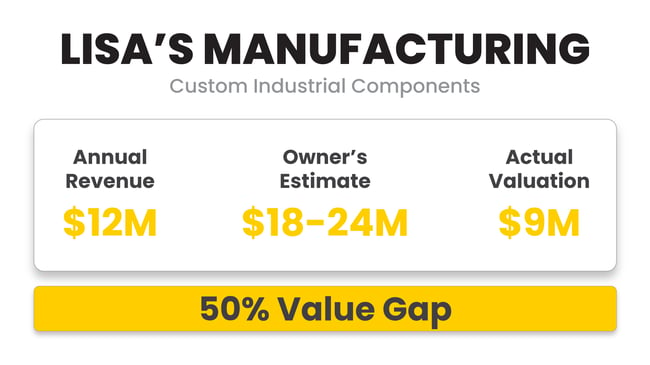
Meet Lisa. She owns a specialty manufacturing company producing custom industrial components. They generate $12 million in annual revenue. When asked about value, she quickly responds: "I've seen manufacturing companies sell for 1.5-2x revenue, so mine's worth about $18-24 million."
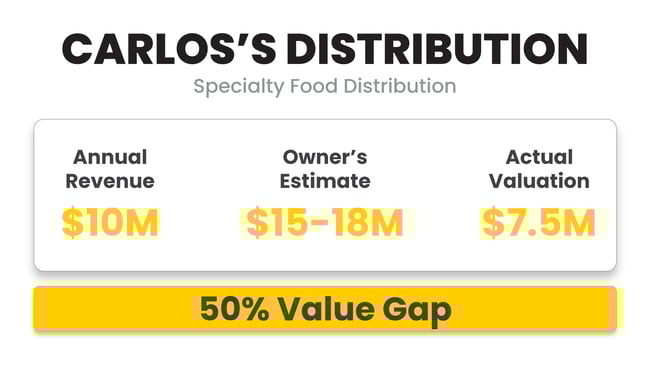
Meet Carlos. He runs a specialty food distribution company with $10 million in yearly sales. His calculation? "I've put $4.5 million into this business over twelve years, plus my expertise. It's easily worth $15-18 million."
Here's what happens when they both get professional business valuations:
Lisa discovers her manufacturing company is only worth $9 million - 50% less than her estimate. Why? Heavy dependence on a few large contracts, outdated equipment affecting efficiency, and lack of documented processes for quality control and operations.
For illustrative purposes only.
Carlos learns his distribution business is only valued at $7.5 million - 50% below his expectations. His investment and expertise, while meaningful to him, create no transferable value for a potential buyer.
For illustrative purposes only.
This is what we call the Value Gap - the difference between what your business is currently worth and what it could be worth with proper planning.
The Value Gap isn't just about wrong numbers. It's the difference between what your business is worth and what it could be worth.
There are three critical misconceptions that lead successful business owners to make less than optimal financial decisions:
- Assuming your business follows generic market "rules"
- Believing what you invested equals what you'll receive
- Thinking your personal effort creates market value
If you're a business owner with a company worth $5 million or more, working 60-70 hour weeks, and you've been estimating your business value based on industry chatter or personal investment, this video will show you exactly why that approach could sabotage your exit strategy.
Because here's the reality: roughly 80-90% of many business owners’ net worth is tied up in their business, but without proper planning, you might only recover 60-70% of its true potential value.
I'm David Silver, a Certified Financial Planner and Certified Exit Planning Advisor, and I've helped many business owner clients with strategic exit planning so they can protect what matters and plan for their future.
Today I'm going to walk you through exactly how these three misconceptions work, using a hypothetical case study that shows how we would analyze a real business owner's situation.
Meet Rachel
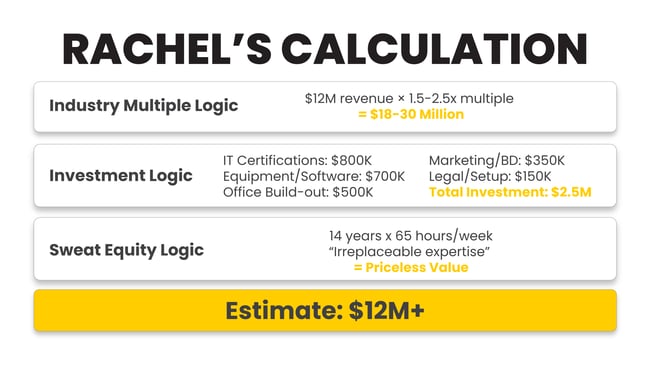
Rachel owns a specialized IT consulting firm serving mid-market healthcare companies. Her business generates $12 million in annual revenue and she's been running it for 14 years. When we ask her to estimate her business value, here's her reasoning:
For illustrative purposes only.
"I've heard IT consulting firms sell for 1.5-2.5x revenue. Mine does $12 million, so it should be worth $18-30 million. Plus, I've invested nearly $2.5 million in specialized certifications, equipment, and building our reputation over fourteen years. Even conservatively, it's worth $12 million minimum."
Sound familiar? Let's examine why Rachel's logic, shared by most business owners, creates such a dangerous value gap.
The first misconception is believing your business follows generic market rules.
Rachel believes that because she's heard "IT consulting firms sell for 1.5-2.5x revenue," her $12 million revenue business should be worth $18-30 million.
Here's what Rachel doesn't understand: Industry multiples are meaningless without context.
When we would analyze Rachel's business properly, we may discover:
- 72% of revenue comes from her personal relationships with four healthcare systems
- Her specialized knowledge exists only in her head - no documentation or training systems
- Her "management team" consists of herself and two part-time family members
- Client contracts are relationship-based with no long-term commitments
Now, when we examine those "1.5-2.5x revenue" sales Rachel referenced, we find they were businesses with:
- Diversified client bases with recurring service contracts
- Documented methodologies and training programs
- Professional management teams with clear succession plans
- Proprietary technology or processes that create competitive advantages
Rachel's business, despite identical revenue, represents completely different risk and transferability. A buyer sees a consultancy that disappears if Rachel leaves, not one that generates predictable future cash flows.
This is why industry multiples without context are not just useless - they're dangerous.
The second common misconception is believing what you invested is equal to what you will receive.
Rachel's second calculation assumes her $2.5 million investment creates $2.5 million in value. This reveals a fundamental misunderstanding of how business valuation works.
Buyers don't care what you invested - they care about future cash generation potential.
When we would examine Rachel's investments:
- $800,000 in IT certifications and training (mostly tied to Rachel personally)
- $700,000 in specialized equipment and software licenses
- $500,000 in office build-out and infrastructure
- $350,000 in business development and marketing over the years
- $150,000 in legal and professional fees for business setup
From Rachel's perspective, this represents value. From a buyer's perspective, we need to ask different questions:
- Are the certifications transferable to new ownership? Mostly no.
- Does the equipment generate measurable ROI? Some does, some doesn't.
- Is the infrastructure essential for operations? Partially.
- Did the marketing create lasting competitive advantages? Limited evidence.
But the crucial point is that even if these investments created value, that value is already reflected in the business's current cash flow. You can't double-count it.
Rachel's $12 million in revenue and her operating margins already incorporate the benefit of her investments. A buyer evaluating future cash flows is looking at the result of those investments, not the investments themselves.
The third misconception is the most emotionally charged: thinking your personal effort or sweat equity creates market value.
Rachel believes that her 14 years of 65-hour weeks create quantifiable market value.
"I've poured my life into this business" doesn't translate to market value.
When we would analyze Rachel's involvement:
- She personally handles all major client relationships
- She's the primary technical expert for complex projects
- She makes all strategic and financial decisions
- She's the face of the company at industry events
- She hasn't taken a real vacation in six years
Rachel sees dedication and irreplaceable expertise. A buyer sees risk and complete dependency.
Here's how we would reframe this for Rachel: Every area where she's personally indispensable reduces the business's transferable value. A buyer doesn't want to purchase Rachel's job - they want to acquire a cash-generating asset that operates independently.
When we would run Rachel's business through a proper valuation analysis, accounting for these realities, here's what we'd discover:
Instead of her estimated $18-30 million, Rachel's IT consulting firm would be valued at approximately $7.5 million.
This isn't because Rachel built a poor business - it's because she built a consultancy that depends entirely on her, without the systems, processes, and transferable assets that create buyer value.
Now, here's the critical part: Rachel's value gap isn't permanent.
But closing it requires understanding the fundamental difference between owner value and market value.
These three misconceptions all stem from the same core error: confusing what creates value for you as the owner versus what creates value for a potential buyer.
The solution isn't just getting a professional valuation, though that's essential. The solution is systematically building what buyers actually want: predictable, transferable cash flows that don't require your/their personal involvement.
This means:
- Developing systems that function without you
- Diversifying revenue sources
- Building management depth
- Documenting everything that currently exists only in your expertise
But here's what most business owners don't realize: this transformation typically takes 3-5 years. Which means if you're planning to exit in the next decade, you need to start building transferable value today.
The Opportunity
The encouraging news is for business owners like Rachel who understand these principles and take systematic action, we can potentially see substantial value increases over 3-5 years. Not through financial manipulation or accounting tricks, but by methodically building what buyers actually pay premium prices for.
In Rachel's case, by addressing her key value detractors systematically, she could potentially increase her business valuation from $7.5 million to $12-15 million over a 5-year period - capturing much more of that original $18-30 million potential.
If you've been thinking about your business value the way Rachel did - using industry multiples, adding up your investments, or factoring in your effort - you likely have a significant value gap.
This isn't about being pessimistic. It's about being realistic so you can take the right actions to maximize your eventual outcome.
The business owners who exit successfully understand that building transferable value isn't just about the final transaction. It's about systematically creating what buyers want while you still have time to make the changes that multiply your business worth.
The first step is getting complete clarity on where you stand today. That's why we've created our comprehensive Exit Readiness Assessment, a detailed evaluation that examines not just your business value, but your readiness across all critical exit planning dimensions.
Take our Exit Readiness Assessment now and receive a score showing exactly where you stand and what specific steps will help maximize your business value.
Because the cost of overestimating your business value isn't just disappointing numbers - it's making the wrong decisions about your entire financial future and your life’s work.
Don't let the Value Gap derail your exit strategy. Get the clarity you need to build real, transferable wealth.
Schedule a conversation with our team to discuss your situation and explore how we can help.