

Three things happened in the third quarter of 2026 that do not usually happen together. Interest rates rose. Inflation stayed elevated. Stocks advanced anyway.
In our Q3 2026 Market & Economic Update, CEO David Silver and Chief Investment Officer Matthew Harbert, CFA, walk through why those seemingly contradictory outcomes occurred and what we are watching as the year closes. You can watch the full conversation or read the recap below.
The Fed took another step toward tighter policy
At its September 16 meeting, the Federal Reserve raised its policy rate by 25 basis points, bringing the target range to 3.75% to 4.00%. The decision was not a surprise. At quarter end, futures markets were assigning a high probability of at least one more increase before year end.
What matters more than the decision itself is the reason behind it. A Fed responding to an overheating economy faces a very different environment from one confronting higher inflation and slowing growth. That distinction shapes everything else in this quarter's story.
A rate hike is not a forecast
It is worth looking at how stocks have historically behaved once the Fed begins raising rates, because the assumption that higher rates mean lower equity prices is more intuition than evidence.
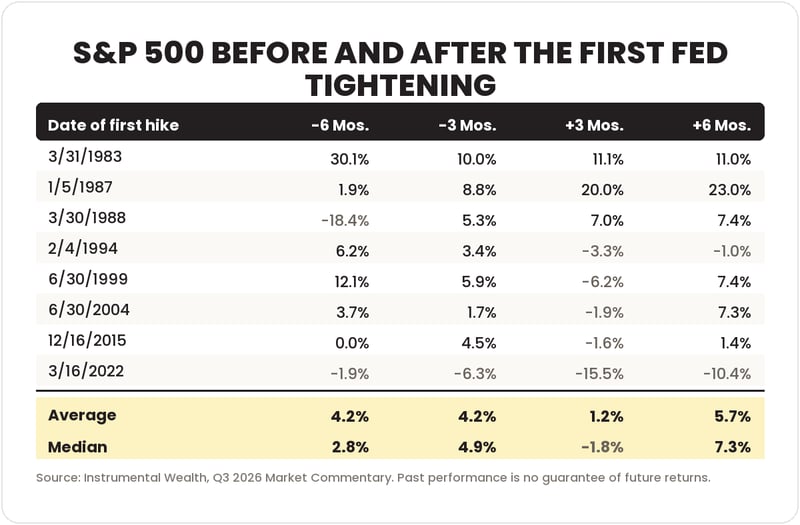
S&P 500 performance before and after the first Fed tightening, eight periods from 1983 to 2022
Across the eight tightening periods we reviewed, the S&P 500 averaged a gain of about 1% in the three months following the first increase and nearly 6% over the following six months. Individual outcomes varied considerably, including real losses in 1994 and 2022.
None of that is a prediction that equities will gain from here. It does show that higher policy rates do not automatically produce losses.
Stocks advanced while bond yields rose
One of the more surprising developments in the quarter was the divergence between stocks and bonds. The 10-year Treasury yield increased by approximately 82 basis points. As yields rose, bond prices generally declined, and nearly every major fixed income sector posted a negative return. Equities, for the most part, moved higher.
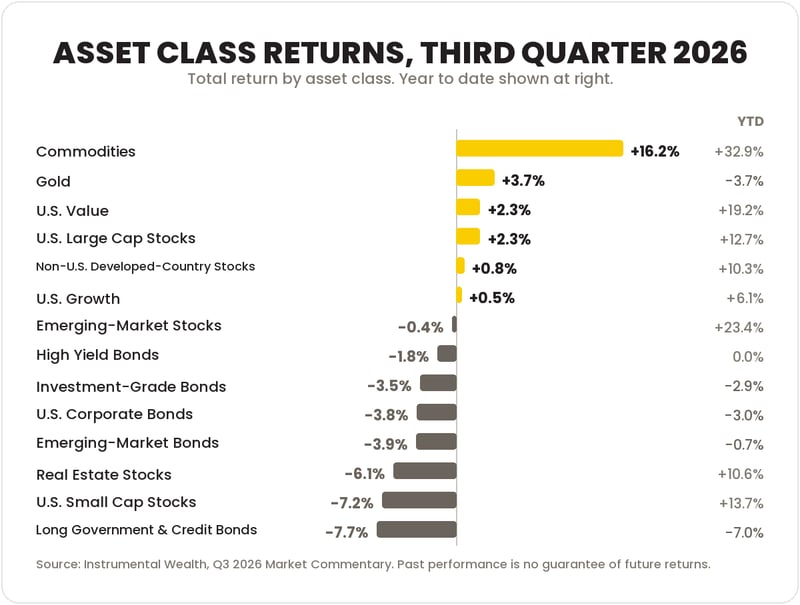 Asset class returns for the third quarter of 2026, with year to date at right
U.S. large-cap stocks gained about 2.3%. International developed markets were up slightly at 0.8%, while emerging-market stocks slipped 0.4%. On the bond side, investment-grade bonds fell around 3.5%, and long government and credit bonds declined about 7.7%. The sharpest losses landed in longer-duration fixed income, which is particularly sensitive to rising yields.
So why did stocks hold up in an environment that would ordinarily create a headwind? The resilience of the underlying economy and the corporate sector.
Corporate earnings remained strong, with S&P 500 profit margins at historically elevated levels, and business capital spending continued to provide support. The labor market showed signs of stabilization. Global manufacturing indicators stayed in expansionary territory. Consumer spending held up.
Those conditions offset some of the pressure from higher borrowing costs and higher discount rates. Interest rates are an important factor, but they are only one part of the equation. Earnings and economic growth matter too.
Inflation proved harder to contain
The third major development was inflation. Rather than steadily moving back toward the Fed's 2% target, several measures reaccelerated during the quarter.
Higher energy prices and tariffs pushed goods inflation to roughly 4% year over year. Services inflation also moved higher, to approximately 3.1%. More importantly, inflation became more widespread, with an increasing number of consumer-price components turning higher.
Households have felt that pressure. Consumer sentiment declined to historic lows over the quarter, which points to a disconnect worth sitting with: consumers may still be spending, but they are not feeling optimistic about their finances.
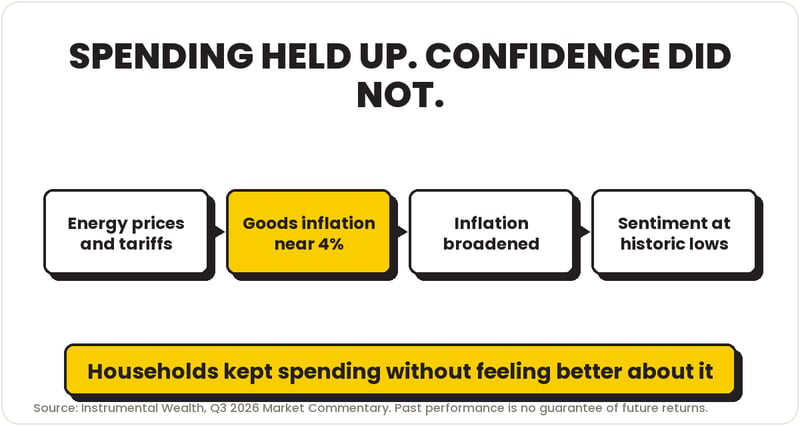 Energy prices and tariffs pushed goods inflation higher while consumer sentiment fell
Gasoline prices are a meaningful part of that. They do not determine confidence on their own, but they are a large contributor to why households can feel squeezed even while employment and spending remain relatively healthy.
Looking ahead
How much further does the Fed go?
Market expectations at quarter end pointed to another possible increase before the end of 2026. Whether that happens depends on incoming inflation and economic data. If inflation stays elevated while employment and spending stay firm, policymakers may have reason to maintain a restrictive stance. A meaningful slowdown in activity could change that calculation. No single expected rate path should be treated as a certainty.
What does diversification look like if inflation stays stubborn?
If stock and bond correlations remain elevated, the answer is not to abandon either one. Both have important roles in a diversified portfolio. It does mean considering whether additional sources of diversification may be appropriate, such as commodities, gold, or selected real estate exposure. Each carries its own risks and none is a universal solution.
What would change the picture?
Credit conditions. Markets can usually adjust to higher rates as long as businesses can continue to finance themselves. The more serious problems emerge when that financing becomes difficult or unavailable. For now, credit spreads are relatively tight, default rates are low, and access to refinancing is available. A sharp widening in spreads, rising defaults, or difficulty rolling over debt would deserve closer attention.
That question is especially relevant given the large technology companies driving much of the market's performance. Market concentration and enthusiasm around artificial intelligence deserve scrutiny. Today's leading companies generally have meaningful earnings and cash flows, which puts them in a different class from the unprofitable dot-com businesses of the late 1990s. That does not eliminate valuation risk. It means evaluating the underlying fundamentals rather than relying on a historical analogy.
As we enter the final quarter of 2026, our message is balanced. Inflation and higher interest rates remain meaningful challenges, but corporate earnings and economic activity have helped markets absorb those pressures better than many expected.
Through all of it, our approach has not changed. We will continue to monitor Fed policy, inflation trends, and credit-market conditions while keeping our focus on disciplined, diversified portfolio construction rather than reacting to every headline.
---
Instrumental Wealth is an investment adviser in Tampa, Florida. Instrumental Wealth is registered with the Securities and Exchange Commission (SEC). Registration of an investment adviser does not imply any specific level of skill or training and does not constitute an endorsement of the firm by the Commission. A copy of Instrumental Wealth's current written disclosure brochure is available through the SEC's website.
Not an offer: This document does not constitute advice or a recommendation or offer to sell or a solicitation to deal in any security or financial product. It is provided for information purposes only and on the understanding that the recipient has knowledge and experience to understand and make an evaluation of the information, the risks associated therewith, and any related legal, tax, or other material considerations. To the extent that the reader has any questions regarding the applicability of this information to their specific situation, they are encouraged to contact David Silver or consult with the professional advisor of their choosing.